Everything is a cycle (including AI).
Railroads, electricity, the internet — every technology boom rhymes: overbuilding on debt, a bust, then the real payoff. Where are we in the AI cycle, and when do you reduce risk?

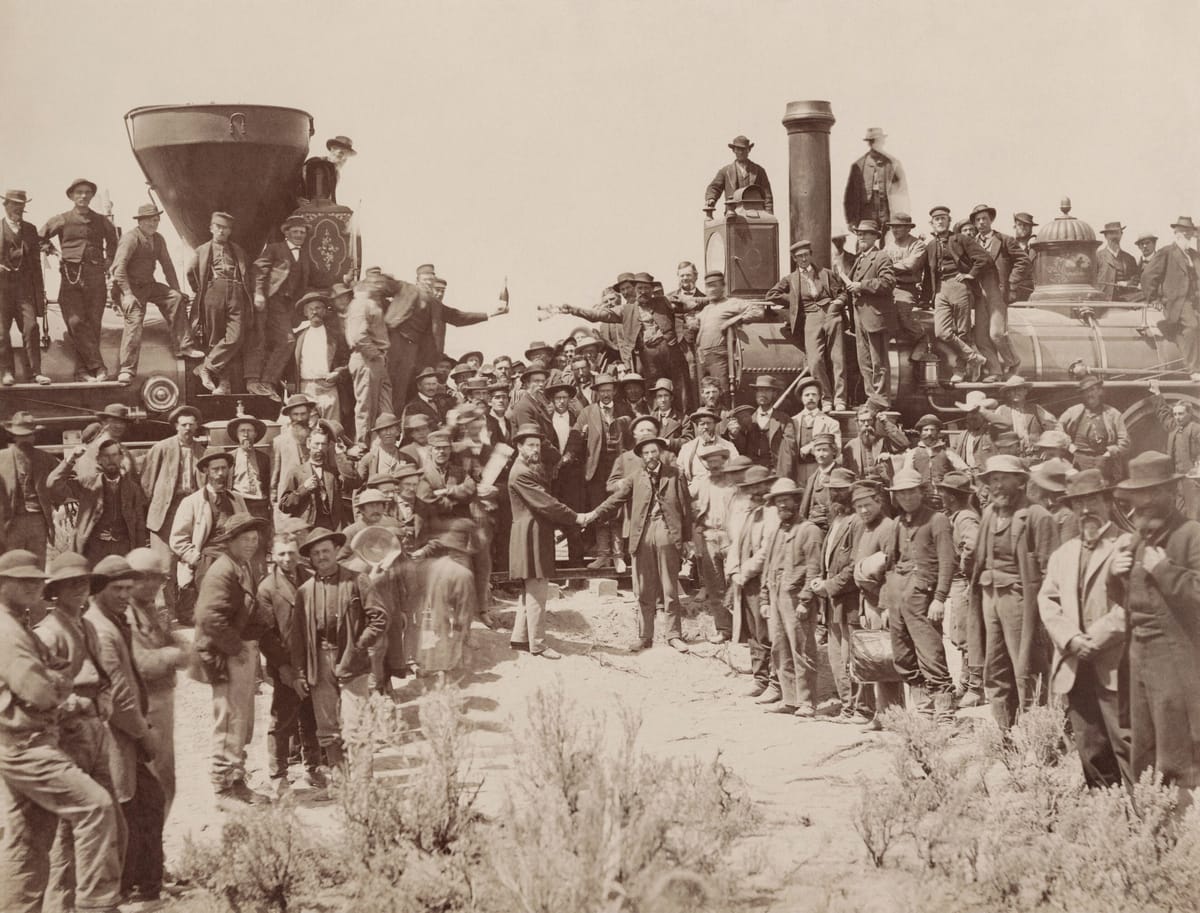
I'm a student of history, and much of what happens in the market has already happened before. Human greed is old as time. The broad strokes of the AI bubble and cyclical memory spending only touch the surface of understanding the root of these cycles. I assert that if you increase the time horizon, everything is a cycle. The Roman Empire was a cycle. Was that cycle 500 years — ending when the Western Empire fell in 476 CE, when Constantinople fell in 1453 CE, or when the Holy Roman Empire dissolved in 1806 CE? You see where I'm going with this: timing is important, and definition is important.
The topic I want to focus on is the AI cycle. My story started with a 33 MHz computer and a 2400-baud modem — mid home-PC cycle, and pre-internet cycle. I built an internet company at age 16 and sold it by 23, with servers colocated in datacenters. I wish I could pull the magazine that featured me in Young Money, but it's lost to time. After 26 years or so, the AI opportunity presented itself — to me, and to us all. I played it well, riding $NVDA early in January 2023, then flipping to $TSLA, $HOOD, and $RKLB, and later into $INTC, $MU, and $NBIS. I grew my net worth from $1.2M to $13M on this cycle. The most important question for me now is when to reduce risk. Like I've said many times, you don't have to be right about a lot of things; you just have to be right on the few things that matter — and I think this is one of those.
Every time period and technology is different, but if you change the way you think, you'll realize they have a lot in common. Consider the following technological cycles:
Railroads — The railroad was the economic backbone that brought the boom to the economy of the early 1800s and the industrialization period. They were built for moving freight; passenger transport emerged as the surprise mass-market demand, though freight remained the enduring economic backbone.
Electricity — The first use case was the light bulb: lighting streets and homes. The bigger economic payoff (industrialization, productivity) came well after the bust.
Internet — Email and the web were the primary killer products. E-commerce and search came later.
AI — ChatGPT, agentic LLMs, then who knows?
Every cycle, there was an overbuilding ahead of supply though overleverage, but the infrastructure endured and became the economic backbone.